- Financial Survival Network
- Posts
- Miracle in Washington? Ozempic and Mounjaro Could Save Medicare and Medicaid
Miracle in Washington? Ozempic and Mounjaro Could Save Medicare and Medicaid
Chronic disease is bankrupting Medicare. A new class of metabolic drugs may finally change that.

Kerry Lutz
March 14, 2026
For decades Washington has wrestled with the same problem: America’s healthcare system is slowly going broke. Every election cycle brings the same promises—cut costs, improve outcomes, save Medicare, fix Medicaid. Yet every year the numbers get worse as chronic disease spreads and treatment costs explode. Now, in one of the great ironies of modern politics, Big Pharma may have accidentally handed Washington the solution.
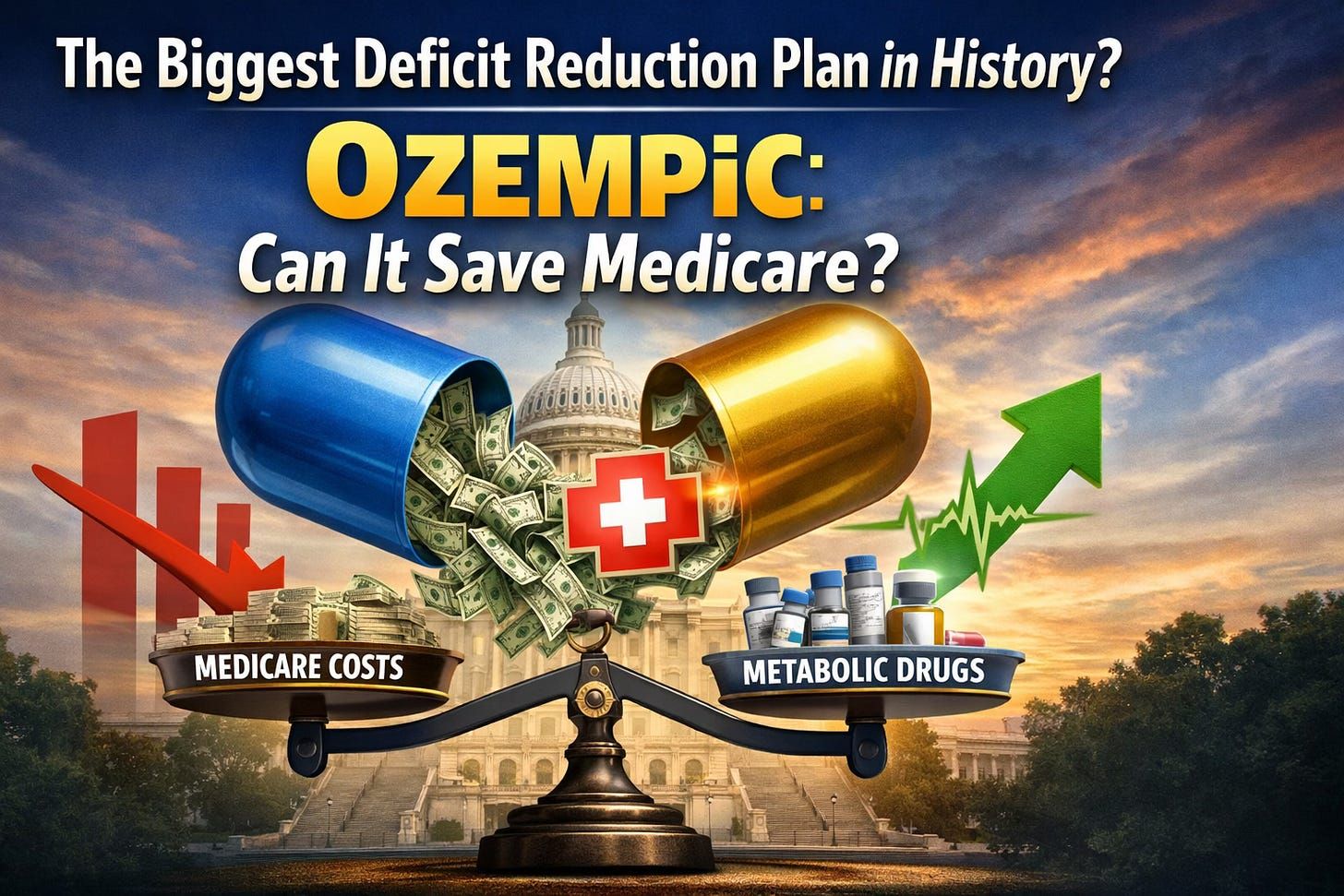
Programs like Medicare and Medicaid spend staggering sums treating diseases that are largely the downstream effects of metabolic dysfunction. Medicare alone now spends over $1 trillion per year, making it one of the largest line items in the federal budget. Roughly 90% of that spending goes toward people with chronic diseases, many of which are directly linked to obesity and metabolic dysfunction. Even more striking, just five percent of patients account for nearly half of Medicare spending because of severe chronic conditions.
Diabetes alone costs the Medicare system an estimated $200+ billion annually when complications and associated conditions are included. Obesity-related illnesses overall account for roughly $170 billion in healthcare spending each year across the U.S. healthcare system. Treating kidney failure through dialysis—often caused by diabetes—can cost over $90,000 per patient per year, and Medicare covers the majority of those cases. Cardiovascular disease, another major metabolic complication, costs the U.S. healthcare system more than $300 billion annually.
These conditions are not isolated illnesses but symptoms of the same metabolic breakdown. Treating them for decades is enormously expensive. What if you attacked the root cause instead of the symptoms? That is exactly what the new generation of metabolic drugs appears to be doing.
Medications like Ozempic and Mounjaro regulate appetite, insulin response, and metabolic signaling throughout the body. Patients frequently lose 15–25% of their body weight while dramatically improving blood sugar control and cardiovascular risk. In many cases type-2 diabetes goes into remission entirely. When metabolic health improves, a cascade of other expensive medical problems often improves as well.
The implications for government healthcare spending are enormous. Chronic metabolic disease drives a huge percentage of the cost inside Medicare and Medicaid. Dialysis, insulin treatment, amputations, cardiac procedures, and stroke rehabilitation cost hundreds of billions every year. Reduce metabolic disease even modestly and the savings compound across the entire healthcare system.
This is where the political opportunity appears. President Donald Trump has pushed aggressively to drive down the price of these drugs and increase competition in the peptide market. Prices that once ran over $1,000 a month are beginning to fall as manufacturing expands and alternatives enter the market. As costs drop, access expands dramatically. Once millions of Americans can afford these treatments, the economic impact becomes impossible to ignore.
And the story does not end with today’s drugs. Pharmaceutical companies are already developing the next generation of metabolic controllers. One of the most promising is the so-called “triple-G” therapy, a multi-hormone drug currently being developed by Eli Lilly. Early research suggests these next-generation drugs could deliver weight-loss results rivaling or even exceeding bariatric surgery while further improving metabolic regulation and inflammation control.
At this point it is worth addressing the critics. Some natural-health advocates insist the answer is simply fasting, strict low-carb diets, or other lifestyle interventions. To be clear, those approaches absolutely work and the science behind them is well established. But the reality is that very few people can sustain those regimens long term in the modern food environment.
Public health policy must deal with human behavior as it actually exists, not as we wish it did. If medications can restore metabolic balance and help millions of people escape the spiral of obesity and diabetes, dismissing them on ideological grounds makes little sense. Whatever side effects GLP-1 drugs may cause must be weighed against the devastating consequences of metabolic disease. Type-2 diabetes alone leads to blindness, amputations, kidney failure, heart attacks, and strokes.
That brings us back to Washington. For once policymakers may have a solution that improves health outcomes while bending the cost curve downward. Encourage broader access to metabolic drugs and millions of Americans could avoid the chronic diseases that bankrupt families and government programs alike. Preventing disease early is far cheaper than treating it for decades.
It is rare that a technological breakthrough aligns so perfectly with a fiscal crisis. Yet that appears to be exactly what is happening. Big Pharma, often treated as the villain in healthcare debates, may have delivered one of the most powerful disease-prevention tools in modern medical history.
The real question is simple: Will Washington take the win? Because if these drugs fulfill their promise, the greatest miracle in Washington might not come from Congress at all. It might come from a pharmaceutical lab.
Washington is finally discovering that preventing problems is cheaper than treating them later. The same principle applies far beyond healthcare.
For example, cities across America have quietly built a multi-billion-dollar parking enforcement machine that often ignores the very rules it claims to enforce.
That’s exactly why I wrote America’s Great Parking Scam: You’ve Been Robbed!?!
Before you pay your next parking ticket, read this:
You might discover the system isn’t just inefficient.
It may not even be legal.