- Financial Survival Network
- Posts
- My Silver Dollar Is Worth $100 Now — and It Used to Be Worth $1 🪙
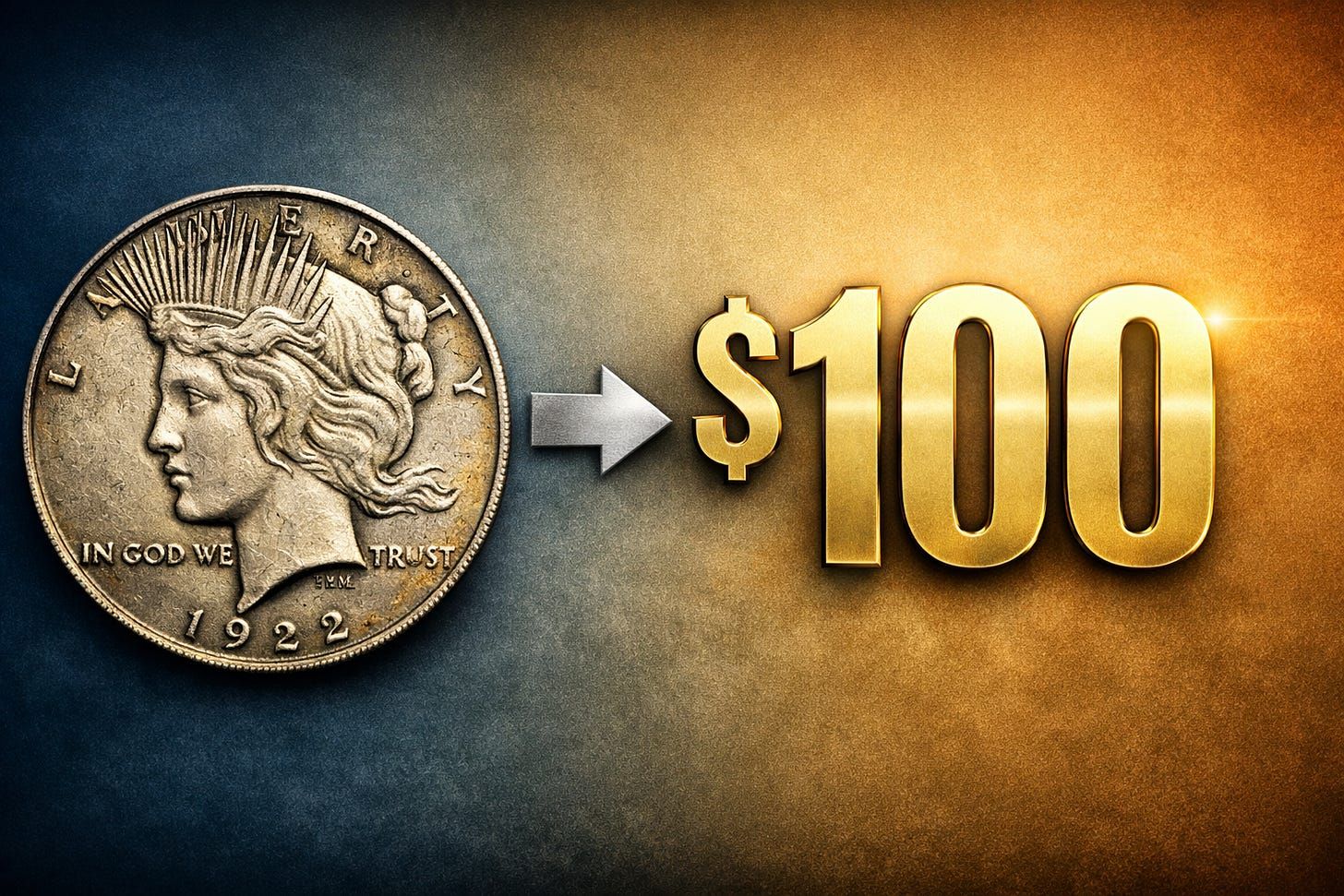
My Silver Dollar Is Worth $100 Now — and It Used to Be Worth $1 🪙
It's worth $66 now but $100 is coming soon...

Kerry Lutz
January 12, 2026
I’m holding a silver dollar as I write this.
It says ONE DOLLAR on the coin. Not metaphorically. Not symbolically. Literally. One dollar, stamped into metal by the United States government.
And yet today, that same coin is effectively on a path toward being worth $100.
Not because it’s rare.Not because it’s collectible.Not because something special happened to this coin.
It’s common. Millions were made. You can still find them if you look.
So how does a dollar quietly turn into one hundred?
Most people’s first instinct is to assume there must be some trick involved. A special year. A rare mint. A collector’s premium. We’ve been trained to think value comes from scarcity or hype.
But this coin isn’t scarce. It didn’t improve with age. It didn’t suddenly become desirable. The coin didn’t change at all. What changed was the thing we use to measure it.
A classic U.S. silver dollar contains roughly three-quarters of an ounce of silver. That silver is still there — the same metal, the same weight, the same chemistry it had a century ago.
What’s different is the purchasing power of the dollar.
Over time, the dollar has been stretched thinner and thinner. Not dramatically. Not overnight. Just steadily, year after year, in a way that’s easy to ignore while it’s happening. So when a silver dollar trades near $100, it isn’t silver doing something wild or irrational. It’s the measuring stick shrinking.
The silver stayed honest. The dollar didn’t.
This is also why $100 no longer sounds extreme.
Silver doesn’t move in straight, polite lines. Historically, when it begins to reassert itself as a monetary reference — even quietly — it moves in bursts. Long pauses are followed by sudden repricing. What once seemed “too high” becomes the new normal.
That’s how something worth $66 today can plausibly trade near $100 in the coming weeks or months without any crisis, panic, or dramatic event.
Nothing has to break.Nothing has to collapse.
Time and arithmetic are enough.
At some point, someone looks at a silver dollar and says something like:
“Wait… this used to be worth one dollar.”
That’s the moment education actually begins.
Not because someone argued with them.Not because they saw a chart.But because the object in their hand contradicts what they were told.
And once that contradiction registers, curiosity follows naturally. People start asking what else once functioned this way. What else held value quietly while the unit measuring it changed.
That’s how understanding spreads — not through lectures, but through realization.
The most important thing to understand here isn’t that silver is “soaring.”
It’s that silver hasn’t changed at all.
A silver dollar worth $100 doesn’t represent excess.It represents honesty meeting a smaller yardstick.
Once you see that, it’s very hard to unsee.
Footnote:As of today, a typical silver dollar is worth roughly $66 based on its silver content. Given current market behavior and historical patterns, $100 is no longer a stretch goal — it’s on the table over the coming weeks or months.
📘 Further ReadingIf this way of thinking resonates, I explore these ideas more deeply in The Armstrong Economic Code — a framework for understanding cycles, money, and why value eventually reveals itself. https://bit.ly/AECode
🚨 Coming SoonI’m also preparing a major exposé on a vast, nationwide revenue scheme that most people interact with regularly but almost no one understands.No hype. No politics. Just documents, math, and sunlight. More soon.
👉 Subscribe here to get the inside track. Its coming very shortly.