- Financial Survival Network
- Posts
- Unsafe at Any Speed: I Don’t Trust Florida’s Railroad — and Neither Should You
Unsafe at Any Speed: I Don’t Trust Florida’s Railroad — and Neither Should You
I don't trust the gates, the horns, the bells and anything else with that railroad.

Kerry Lutz
July 21, 2025
I live in Florida. I cross those tracks. On foot. In a car. Almost daily. And let me tell you something:
I don’t care if the gate’s up. I don’t care if the lights are off. I don’t trust the railroad, and I sure as hell don’t trust the signals.
I’ve learned to look both ways. Twice. I don’t assume anything. Because this isn’t just a corridor — it’s Darwinian Alley of Death.
I never stop on the tracks. Never. I always make sure there’s enough space in front of me to clear them completely before I even begin to cross. And yet, week after week, I watch people pull halfway across and stop at a red light — trapped in the kill zone like frogs on a hot plate.
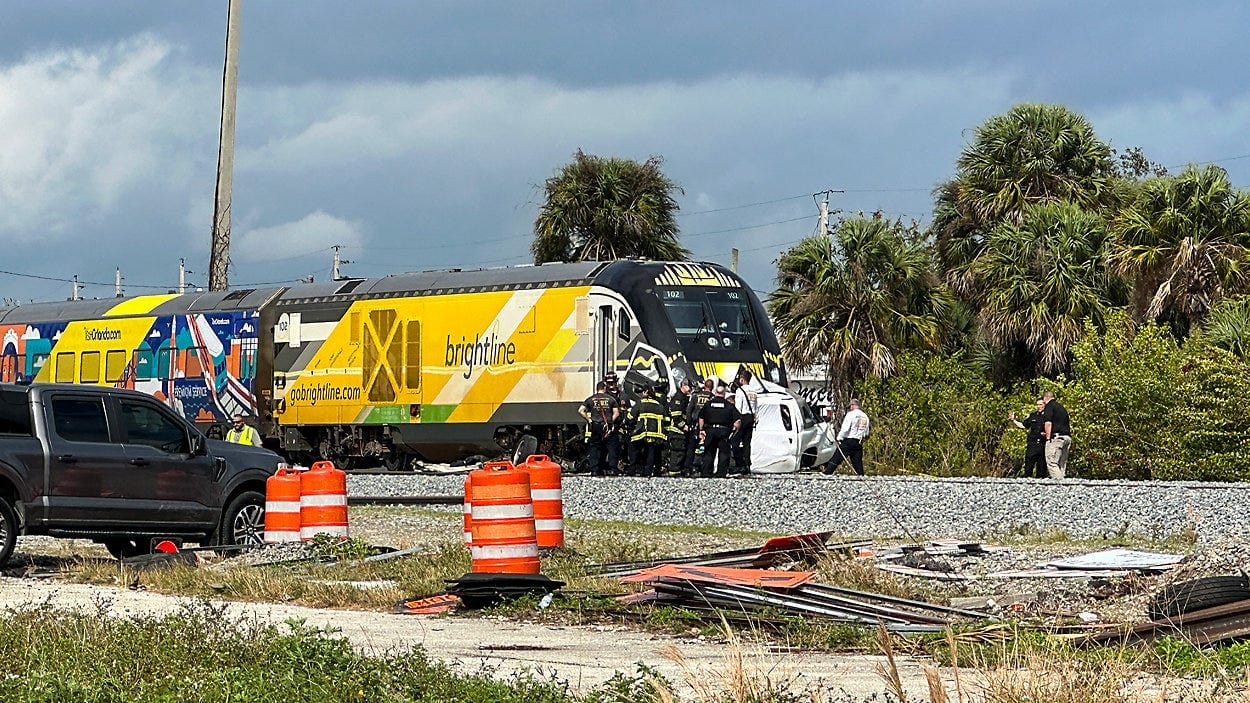
Sometimes, I see them glance in their mirrors, completely unaware of the danger they’ve parked themselves in. And I think: you poor, dumb bastard — one Brightline and you’re paste.
I don’t care what the signals say. If I can, I look for the train myself. Because I know the truth:
You cannot trust Florida’s rail system to protect your life.
They call it infrastructure. I call it Russian Roulette with tax dollars.
Sixty years ago, a quirky guy named Ralph Nader wrote a book called Unsafe at Any Speed. It was about the Chevrolet Corvair — a slick little car that looked great in brochures but killed people in real-world collisions. That book sparked a movement, helped launch the consumer safety era, and got the Corvair taken off the road.
In 2025, we’ve got something far worse than a twitchy suspension. We’ve got an entire rail corridor running through one of the most populated states in America — and it's eating people alive.
The Brightline-FEC corridor is already the deadliest per mile in the country. But now we’re planning to run Tri-Rail on it too. That’s right — slower commuter trains on the same high-speed corridor, through the same pedestrian-packed neighborhoods, with the same unfixed crossings and same zero fencing in places. It’s not a fix. It’s doubling down on a death trap.
And no one — not a mayor, not a transit agency, not a candidate — will say the obvious thing:
What happens the next time Brightline hits a fire truck and derails at 80 mph? What happens when a Tri-Rail train stalls at a crossing and gets T-boned by a freight train? What happens when the Quiet Zone turns into a mass-casualty zone?
Because the truth is simple — and it’s as uncomfortable as it is obvious:
Brightline, Tri-Rail, FEC, and the entire corridor are unsafe at any speed.
I’m not a safety engineer. I’m just a guy who crosses those tracks with my own eyes wide open. But even I can see the obvious:
This corridor is broken.
It’s underbuilt, undersecured, and overwhelmed.
And more trains won’t make it safer — they’ll just make the inevitable disaster bigger.
Florida is arguably the wealthiest state in the country — maybe second only to Texas. We have Palm Beach. Naples. Brickell. We’re not broke. We’re just irresponsible.
Sometimes, you have to do the hard thing. The right thing. The expensive thing.
Sometimes you just have to write the damn check.
Elevate the rail. Fence it. Grade-separate the crossings. Trench it where you can. Redesign it for the 23 million people who live here now — not the swamp ghosts who built it 100 years ago.
I’m a car guy. Through and through. But Florida needs safe, modern rail. That’s a fact.
We just can’t keep running trains through city streets and calling it progress.
That’s not transit — it’s a taxpayer-funded game of Russian roulette.
And it’s long past time we stopped playing.