- Financial Survival Network
- Posts
- WHEN MARKETS DROP, WATCH THE TIMING — NOT THE HEADLINES 📉⏱️
WHEN MARKETS DROP, WATCH THE TIMING — NOT THE HEADLINES 📉⏱️
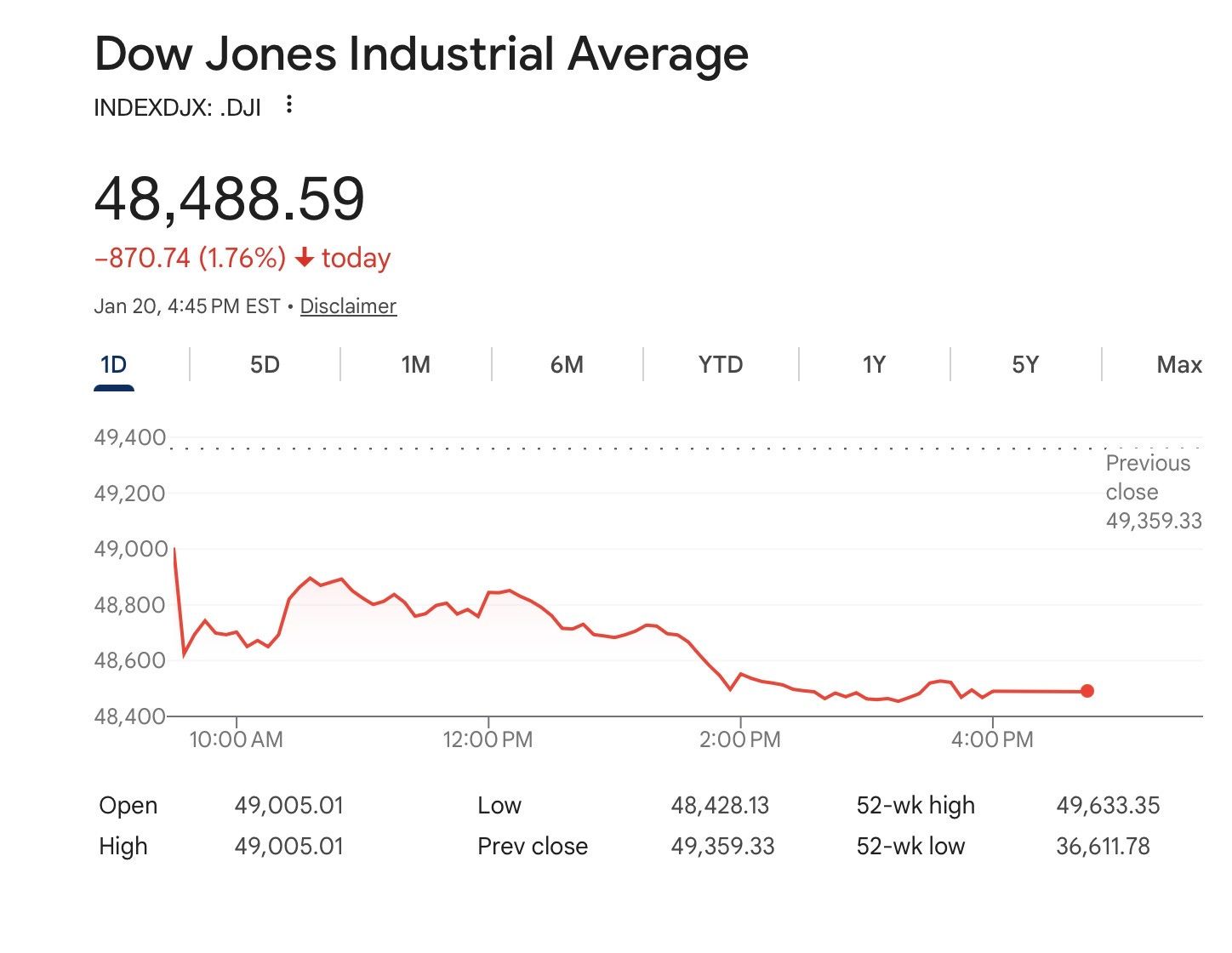
Yesterday’s stock market drop was ostensibly about Greenland 🧊.

Kerry Lutz
January 21, 2026
That was the explanation pushed across the financial media: uncertainty surrounding Donald Trump, Greenland, and renewed tariff pressure on Europe 🇪🇺. Markets don’t like surprises, we were told.
That explanation is tidy.And almost certainly incomplete.
What matters isn’t just why markets were said to fall — it’s when they fell, what they were told to focus on, and what else was happening at the same time 👀.
Because every time something genuinely consequential is being decided, the same pattern appears first:volatility, noise, and distraction.
THIS IS EXACTLY HOW PANIC CYCLES BEGIN ⚠️
At the November 2025 World Economic Conference, Martin Armstrong laid out what he called the approaching 2026 Panic Cycle 📆.
Not a crash headline.Not a single event.
A process.
He described it as a period where:- Confidence fractures unevenly- Markets react to signals, not fundamentals- Political pressure and capital stress begin to overlap- Volatility appears before the public understands why
Critically, he warned the early phase would be misattributed — blamed on whatever headline was most convenient at the time.
That’s precisely what makes panic cycles dangerous:they don’t announce themselves honestly.
DAVOS IS NEVER ABOUT THE SPEECHES 🎤
With Trump appearing at Davos, the narrative snapped instantly into place.Personalities. Optics. “Provocations.” Greenland. Tariffs.
That’s not the real story. That’s the layer.
Davos has never been about what’s said on stage. It’s about alignment, leverage, and timing. The cameras exist so everyone thinks they’re watching the event, while the real decisions happen quietly — often elsewhere, often earlier.
The speeches are for the public.The signals are in what suddenly becomes controversial 🔍.
DISTRACTION IS NOT RANDOM 🧠
When markets wobble at the same moment political rhetoric spikes — and the drop is framed around a single, convenient issue — it’s rarely coincidence.
This is textbook panic-cycle behavior:1. Attach volatility to a digestible headline2. Keep the public arguing about interpretation3. Allow institutional repositioning to proceed quietly4. Let the outcome look “obvious” later
By the time the public recognizes the pattern, confidence has already shifted.
WHY GREENLAND MATTERS — EVEN IF YOU THINK YOU UNDERSTAND IT 🧊
Most people hear “Greenland” and think geography, symbolism, or bluster.
Markets don’t move on symbolism.They move on pressure points ⚙️.
When an issue that seems remote or misunderstood suddenly becomes the official explanation for market volatility — during a period Armstrong specifically warned would be unstable — that’s a tell.
The mistake most people make is watching what’s being emphasized.Professionals watch what’s being avoided.
They ask:- Why this explanation?- Why now?- Why during a predicted panic phase?- What needed cover?
LEARNING TO SEE THE SIGNAL EARLY 👁️
The real edge isn’t prediction.It’s recognizing when a distraction appears exactly on schedule.
There is a reason Greenland became the headline explanation yesterday.And there is a reason the public discussion feels oddly superficial.
What Greenland actually represents — economically, strategically, and politically — is not what most people think. I didn’t fully grasp it myself until I started pulling the thread.
What I found surprised me.
Paid readers will see the full breakdown later this week.
— Kerry