- Financial Survival Network
- Posts
- WHY HIGHER SILVER PRICES MAY BE LOWERING SUPPLY ⚠️🥈
WHY HIGHER SILVER PRICES MAY BE LOWERING SUPPLY ⚠️🥈
Sounds crazy doesn’t it?

Kerry Lutz
January 26, 2026
For most commodities, the rule is simple: higher prices bring more supply.
Producers ramp output, marginal projects come online, inventories are released, and prices eventually stabilize or fall. It’s Commodity Economics 101.
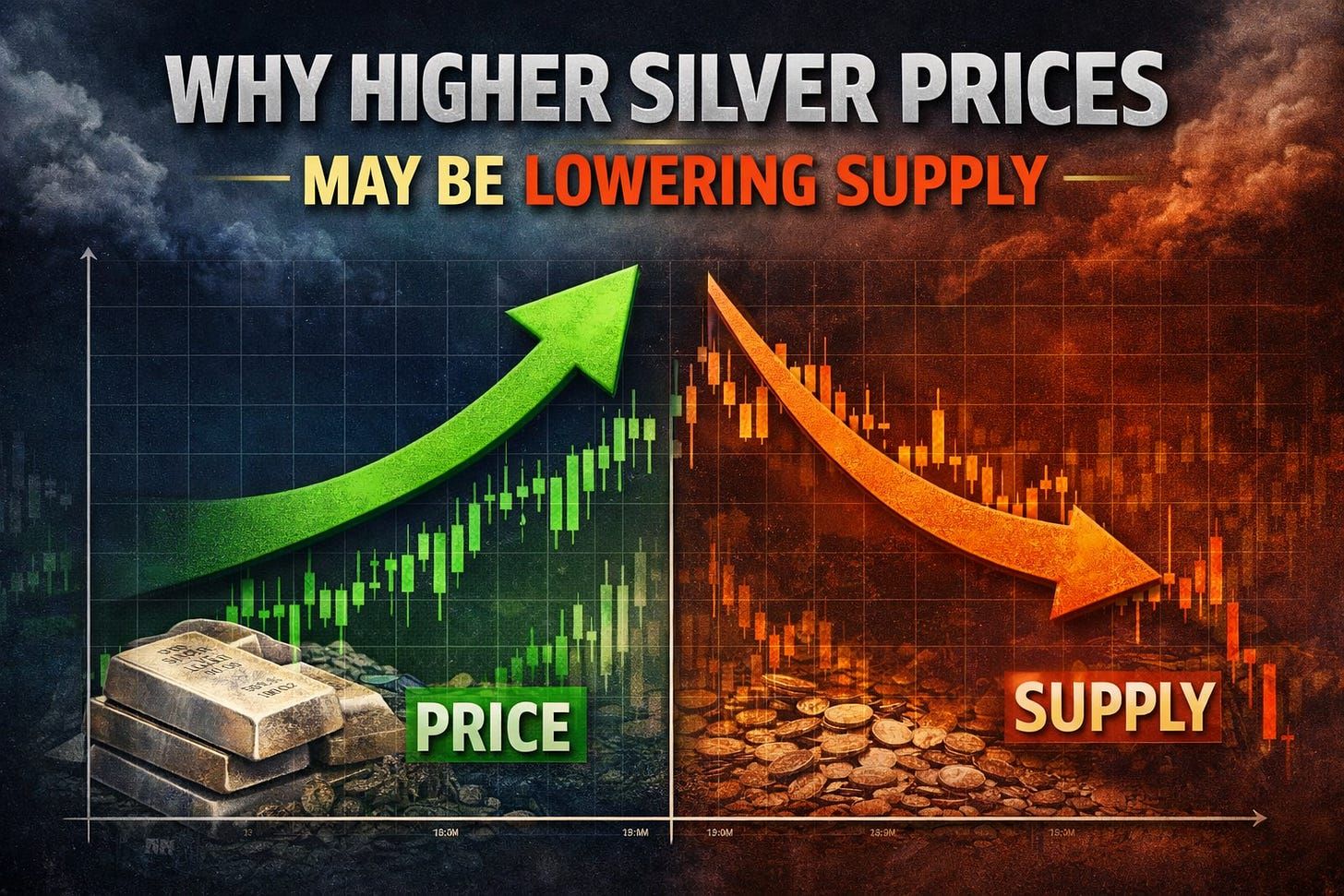
Silver, however, is now doing the opposite 👀
Despite prices reaching levels that would normally trigger a flood of new supply, available silver remains tight, structural deficits persist, and physical premiums continue to widen. There is a growing case that higher silver prices are actually constraining supply rather than expanding it in the short-to-medium term. This is not hype. It is a textbook case of supply inelasticity—and at times negative elasticity—driven by the unique structure of the silver market.
THE STRUCTURAL PROBLEM: BYPRODUCT DOMINANCE 🔩
Roughly 70–80% of global silver production comes as a byproduct of mining operations focused on copper, lead, zinc, and gold. Silver output is not driven by silver prices. It is driven by base-metal economics. Even at triple-digit silver prices, byproduct producers do not expand output unless the primary metal justifies it. If copper or zinc prices soften, silver production can actually decline even while silver prices surge.
NO RAPID SUPPLY RESPONSE ⏳
New silver mines take 5–15+ years from discovery to production. Permitting, environmental approvals, capital intensity, and declining ore grades prevent rapid supply responses. High prices today do not create new silver tomorrow.
WHY HIGH PRICES INCENTIVIZE WITHHOLDING 🧠
Under US GAAP and IFRS accounting rules, mining inventory is carried at the lower of cost or net realizable value. Inventory is not marked up to market prices. This creates a powerful incentive to hold silver inventory during rising price environments. Holding metal defers profit recognition while preserving upside optionality. For byproduct producers, silver is often bonus revenue with little urgency to sell.
STRUCTURAL DEFICITS COMPOUND THE PROBLEM 🔥
Silver has run annual supply deficits for more than seven consecutive years, with cumulative shortfalls exceeding 800 million ounces. Demand from solar ☀️, EVs 🚗, electronics, and industrial uses is price inelastic, with few viable substitutes. Higher prices do not materially reduce demand.
WHY THIS RAISES PAPER MARKET RISK 🚨
When higher prices fail to unlock supply, physical availability tightens while paper claims expand. Futures markets become increasingly stressed. Cash-settlement incentives and rule changes become more likely. This is when markets appear strongest—and are actually most fragile.
BOTTOM LINE 🧩
Silver is not behaving like a normal commodity. Higher prices are not curing scarcity. They are exposing it. These distorted incentives, paper promises, and delayed recognition dynamics are explored further in The Armstrong Economic Code.
Silver is signaling something important.
And signals like this do not come quietly 🦇💥